Mostrar mensagens com a etiqueta hidrossementeira. Mostrar todas as mensagens

Ecossistemas - Especialistas em Jardinagem e Irrigação .


Ecossistemas

Paixão, Profissionalismo e Dedicação

Com mais de 20 anos de experiência na nossa área prestamos serviços desde uma floreira ou vaso a jardim privado e público. Com vasta capacidade em meios e equipamento, associados a uma boa qualidade de trabalhos já realizados nunca desprezamos a manutenção das áreas verdes. Possibilidade de apresentar soluções económicas e ecológicas, com aconselhamento técnico permanentemente e grátis na nossa seleção de serviços principais abaixo descritos.

Prestação de serviços:
Projetos/Recuperação/Construção/Manutenção de Jardins;
Sistemas de rega, Piscinas, Lagos;
Relvado natural ou artificial – Fornecimento, instalação,
Recuperação e Conservação, Semente ou tapetes;
Palmeiras e Árvores – Tratamento (Rhynchophorus)  e Abates;
Limpeza de jardins, matas ou florestas;
Construção Civil – Muros de Pedra; calçadas; decks de madeira e compósito;
Cascatas; pérgulas e vedações;
Garden Center – Comércio de todo o tipo e plantas ornamentais; revestimentos e materiais.

Ofertas:
Quer reduzir os custos de Água, energia e serviços do seu jardim?
Temos a solução para si através de Aconselhamento GRÁTIS

Jardim + Piscina


TRAGA UM AMIGO e nós damos 3 meses grátis de manutenção.
Compras superiores a 370€


Oferta de Plantação no nosso Garden Center.


Ecossistemas
Passion, Professionalism and Dedication
With over 25 years of experience in our field, we provide services from planters or flower pots to private and public gardens. With a vast competence in working with resources and equipment, associated with a good quality of already undertaken work, we never ignore the maintenance of green areas. We can offer economic and ecological solutions, with permanent and free technical advice within our selection of main services described below.

Provision of Services
·        Projects / Restoration / Building / Garden Maintenance;
Irrigation systems, Pools, Ponds;
·        Natural or Artificial Lawn – Supply, Installation, Restoration and Maintenance, Seed or Carpet grass;
·        Palm  and Trees– Treatment (Rhynchophorus) and Logging;
Garden, woods and forest Cleaning;
·        Construction– Stone walls; sidewalks; wood decks and composite;
Waterfalls, pergola and fences;
·        Garden Center – Trade of all kinds of ornamental plants.

Offers:
Want to reduce the costs of water, electricity and services of your garden?
We have the solution for you through FREE TECHNICAL ADVICE
·        POOL + GARDEN
BRING A FRIEND and we will offer 3 months of free maintenance.
·        Purchases over € 370
Planting supply in our Center & Nursery


Ecossistemas

Leidenschaft, Professionalität und Hingabe
Mit mehr als 25 Jahren Erfahrung in der Branche bieten wir Service und  Ausstattung  vom Blumentopf oder Pflanzkübel bis hin zu privaten Gärten oder öffentlichen Parkanlagen. Mit unserem umfangreichen Equipment, gepaart mit erstklassiger Arbeitsqualität, haben wir schon oft unter Beweis gestellt, dass uns die Pflege von Grünanlagen am Herzen liegt.  Wir bieten ökonomische und ökologische Lösungen und dauerhaft kostenlose technische Beratung bei Ihrer Auswahl aus folgenden Dienstleistungen:
Serviceleistungen:
·        Entwürfe/Wiederherstellung/Anlage und Gestaltung/Instandhaltung von Gärten;
Bewässerungssysteme, Pools, Teiche;
·        Natur- oder Kunstrasen – Lieferung und Verlegung,
Restaurierung und Pflege, Aussaat oder Fertigrasen;
·        Palmen (Schädlingsbekämpfung bei Rhynchophorus) und Bäume – Behandlung und Entsorgung; Reinigung von Gärten, Wald und Forst;
·        Aufbauten – Steinmauern, hölzerne oder gepflasterte Wege und Kunstböden;
Wasserfälle, Pergolen und Zäune;
·        Garten Center – Verkauf von Zierpflanzen aller Art, Beläge und Materialien.

Angebot:
Möchten Sie die Kosten für Wasser, Strom und Gartenarbeit senken?
Wir beraten Sie kostenlos über mögliche Lösungen.

·        Garten + Pool
Bringen Sie einen Neukunden mit und wir bieten drei Monate Instandhaltung gratis.
·        Bei Einkäufen über 370€
Wir schenken Ihnen das Einpflanzen.


Production, trade, import and export of plants, trees, shrubs, gardening articles.

Production, le commerce, l´importation et l´exportation de plantes, arbres, arbustes, des articles de jardinage.
Produktion, handel, import un export von pflanzen, Baumen, strauchern, gartenartikel.


 Production, trade, import and export of plants, trees, shrubs, gardening articles.

Production, le commerce, l´importation et l´exportation de plantes, arbres, arbustes, des articles de jardinage.

Produktion, handel, import un export von pflanzen, Baumen, strauchern, gartenartikel.


Development could threaten Annette Hoyt Flanders-designed former Lehman estate


Lyndhurst and Willowpond LandscapeWillowpond, image courtesy Paul Barrett.

Proposed zoning amendments in Tarrytown’s Historic Commons District could lead to development of Willowpond. The estate, once home of Harold Lehman of the Lehman Brothers banking family, contains the remnants of a once grand garden designed by noted landscape architect Annette Hoyt Flanders. Insensitive development could destroy this landscape and negatively impact the views from Lyndhurst, the National Trust for Historic Preservation site and National Historic Landmark that borders the parcel.

History

Annette Hoyt Flanders

Annette Hoyt Flanders.

In 1915, Sigmund Lehman and his sons, members of the successful Lehman Brothers investment banking family, built three contiguous estates along the banks of the Hudson River in Tarrytown, NY. The homes, Sigmund’s "Millbrook," Allan’s "Elmbrook," and Harold’s “Willowpond,” were set within the Hudson Valley’s Mansion District, where, at the turn of the 20th century more than thirty country estates—getaways for the “Titans of Industry”—defined the landscape along the Hudson River.


Harold and Cecile Lehman’s taste in architecture favored the Colonial Revival trend popular at that time. It was a fresh, clean, and youthful step away from the Victorian styles fashionable just a few years earlier. The Lehman’s commissioned the Philadelphia architect Frank Newman to design their new home. Newman transformed the existing 1859 granite villa on the site into a rambling Georgian Colonial mansion. The mansard roof was raised, brick veneer covered the granite, wings were added to the north and south of the villa core and an impressive 3-story columned portico was added creating a dramatic riverfront façade.

The unconventional thinking of the Lehmans extended into the landscape, which landscape architect Annette Hoyt Flanders was commissioned to design in the 1920s. Flanders was one of a small group of well-known women landscape architects at the time making notable strides in a field dominated by men.
Willowpond House


Willowpond Roses
(upper) the Lehman house prior to demolition; (lower) Willowpond gardens. Images
courtesy Paul Barrett.
For the Lehmans, Flanders laid out terraces, staircases, garden walls, fountains, fish ponds and allées, incorporating into her design “borrowed scenery,” of neighboringLyndhurst, the Hudson River and the distant Palisades. Flanders’ prominence soared in the 20s and 30s and photographs of her commissions from across the country, including her Country Place era design for the Willowpond, were featured in leading home, garden and architectural magazines.


Flanders’ basic rule for gardens was that they should be perfectly adapted to the terrain and to the use for which they were intended to serve. The formal gardens at Willowpond were organized around two perpendicular axial walks: First, the north/south axis served to draw visitors away from the house. This walk, with its alternating sunlit and shadowed path, terminated in a terraced garden room with a fountain as its central focus. 

The second axis opened up vistas to the surrounding landscape. Originating in a sunlit, geometric garden with a cement fishpond at its core, this east/west axis intersected the brick terrace and descended a flight of stairs. From here, one would travel down a shaded allée of pine and magnolia towards a broad view of the Hudson River with the hills beyond. A circular enclave halfway down the walk provided an alternate vista looking southwest, across the unbounded lawns and meadows of neighboring Lyndhurst, and over the Hudson with the Palisades as a backdrop in the near distance.
Willowpond Steps


Willowpond Steps
(upper) stairs and garden previously; (lower) stairs (current condition). Images
courtesy Paul Barrett.
The Flanders plan for the Lehmans may have only encompassed a very compact portion of the entire estate. However, the plan provided for an easy transition to and from the larger naturalistic landscape and Flanders’ formal garden.

In the mid-1950s neighboring Millbrook and Elmbrook were acquired by the General Foods Corporation. Willowpond followed suit in 1975. General Foods razed the houses and established a corporate campus on the Millbrook and Elmbrook properties.  After the sale of Willowpond, the Georgian Colonial mansion was demolished to make way for the creation of a 60-space parking lot. The parking area was never constructed and the Flanders landscape went to ruin. Plants and shrubs were removed; garden ornaments such as marble garden benches, flagstone walkways, and fountain ornamentation were stolen or vandalized. Ornamental trees and shrubs that remained have grown wild and 40 years of undergrowth have taken over the site, leaving it virtually impassable. However, vital architectural elements remain a testament to the early 20th-century Country Place Era landscape in America, a time when property owners invested in extravagant, European-inspired landscapes, and a signature of one of America’s first, and highly acclaimed, female landscape architects.

Goldfish Pond
Goldfish pond (current condition). Image courtesy Paul Barrett.

Threat

Tarrytown has proposed zoning amendments to clarify inconsistencies in the current code.  Some aspects of the proposed amendments are protective. However, others—such as new provisions to allow multi-family senior housing—could result in development that could obliterate the existing Flanders landscape.
The proposed zoning amendments could also result in the encroachment of new buildings into Lyndhurst’s viewshed. Constructed in 1838, the Gothic Revival style mansion was designed by noted architect Alexander Jackson Davis and served as home to three prominent American families. Bequeathed to the National Trust for Historic Preservation in 1961 and designated a National Historic Landmark in 1966, it survives as a rare vestige to Gilded Age glory. While three of its four borders are protected, its northern boundary, adjacent to Willowpond, is vulnerable due to the Lehman Estate's vacancy and redevelopment threats.

Twitter brings nature indoors with a green wall in its headquarters


Green walls, also known as living walls, are a rising trend in green design, popping up everywhere as homeowners and businesses want to incorporate nature into their buildings.
Twitter Inc. is the latest company to incorporate this trend as it recently expanded its headquarters in San Francisco. Bringing a fresh interior to a new floor, the Twitter installation includes a 225 sq. ft. GSky Versa Green Wall.
The GSky Green Wall is nestled in the floor’s common room – an ideal spot for a beautiful piece of living art. The GSky Green Wall adds aesthetics to the room by creating a greener and healthier work environment.
According to Debbie Kotalic, GSky’s Director of Artistic Horticultural Design, the GSky Green Wall brings an organic feel to the Twitter office.
“Twitter wanted a simple design with a uniform green color to complement the Twitter bird logo, which in this setting is made of wood,” Kotalic said. “It is important to have the iconic bird logo be the focal point of the wall, so we provided a flattering backdrop with depth and texture, fashioned by plants to establish a continuous flow that is quite captivating. There is definitely complexity in its simplicity.”
The aesthetic appeal isn’t the only benefit of Twitter’s new Green Wall: adorned in 1,008 fresh potted plants, nature is brought from the outside in, creating a peaceful and calm environment. It has been proven that indoor plants provide plenty of health benefits. The process of photosynthesis consumes CO2 and releases O2, which gives people more energy-rich oxygen to breathe better. The calmer environment created by the plants helps to reduce stress and improve mental well-being, and in turn enhances the employees’ creativity and productivity.
“We are extremely pleased with how Twitter’s new Green Wall turned out,” Dan Ballay says. People are really excited to see more plants inside the office assembled in a way that is modern and fresh. The use of a Green Wall accomplishes both aspects with style.”
GSky’s Versa Wall System is user-friendly and easy to install and maintain for any interior Green Wall. It employs 4-inch industry standard pots that can be placed directly into the Versa Wall tray to ensure instant plant coverage, offering flexible installation options and a variety of plant selections. The Versa Wall is eco-friendly, customizable, durable and economical. Additionally, it has a recirculating irrigation system that is water efficient and self-contained.

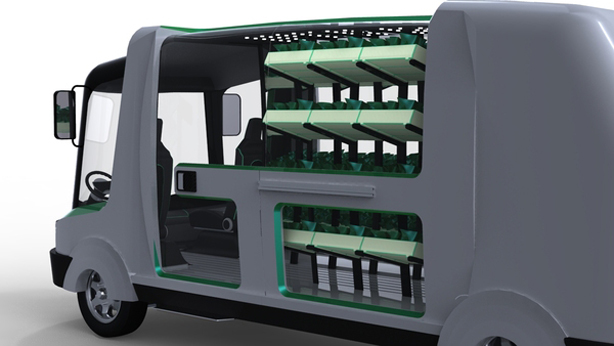
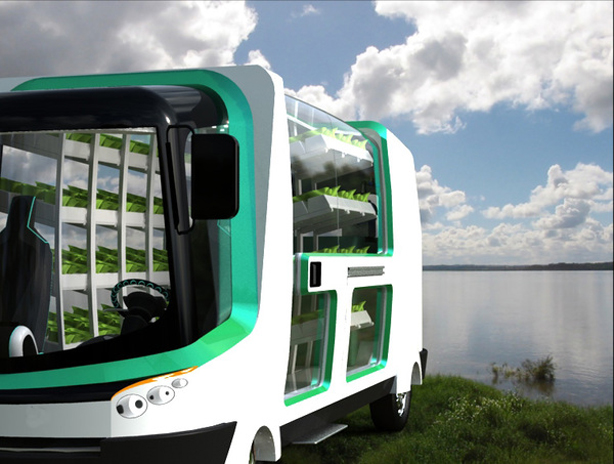
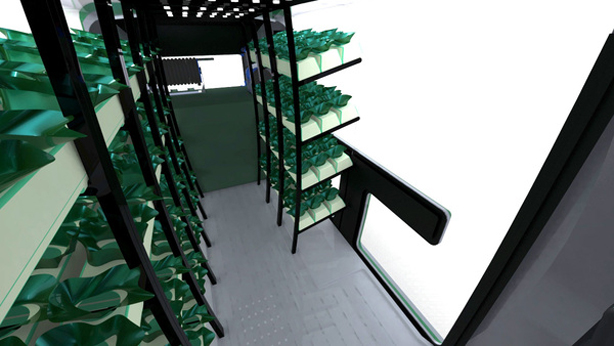
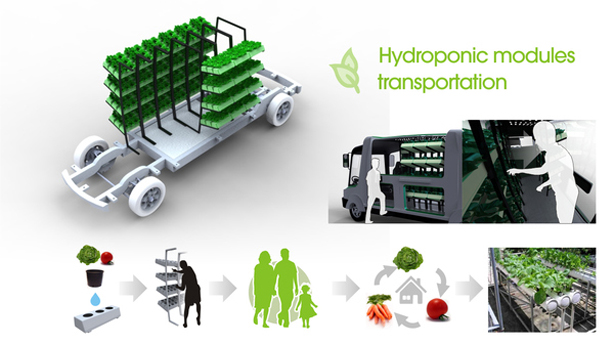
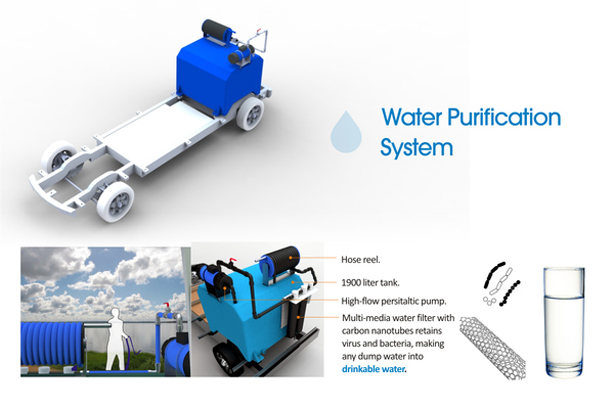
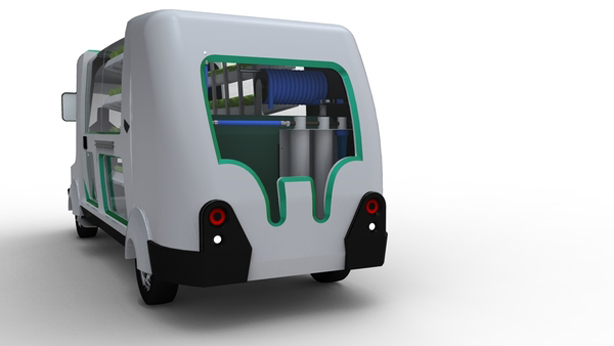
Urban Hydroponic Bus Delivers Fresh Food and Water


Food & Water 2030 is Argentine industrial designer Nicolás Chacana’s concept for the cultivation of hydroponic produce in a mobile farm, specifically, an urban vehicle that grows and delivers food and drinkable water.


I would like to know how energy efficient the concept is. The delivery of fresh food is a good thing for sure, but is this the most efficient way to do so?


The designer envisions the concept in a future scenario, say 2030, when he projects that pure water and food will be scarce due to contamination, global warming and biofuel production. But, wait: hasn’t that day arrived already in many locales?

Luxo italiano em tempo de crise

Fica na ilha italiana de Ischia, algures entre Lacco Ameno e Forio. Um hotel boutique com mais de 400 anos de história. O Mezzatore Resort & Spa quase faz com que esqueçamos a crise e o corte no rating de Itália.


A produção na construção continua em queda com uma variação homóloga negativa de 10,1 % em Agosto, uma taxa inferior em 0,2 % à observada em Julho.
Segundo o Instituto Nacional de Estatística, a actividade "continuou a diminuir em Agosto, tendo-se registado uma variação menos negativa na construção de edifícios, enquanto o índice para o segmento da engenharia civil diminuiu mais intensamente em Agosto face ao verificado no mês anterior".
O índice relativo ao segmento de construção de edifícios apresentou uma variação homóloga de -9,1 % (-9,5 % no mês anterior), contribuindo com -4,2 % para a variação do índice agregado.
A produção no segmento de engenharia civil diminuiu 11 % em termos homólogos contra uma redução de 10,3 % em Julho, o que representou um contributo de -5,9 % para a variação total do índice.
Quanto ao volume do emprego no sector, o INE revelou que se registou uma diminuição de 10,2 % em termos homólogos contra os -10,3 % de Julho.


A taxa de variação homóloga das remunerações efectivamente pagas pelo sector "apresentou uma redução de 3,5 % em Agosto, após se ter observado uma variação de -6,9 % no mês anterior".

Relvados

Um relvado é uma superfície uniforme de uma ou mais espécies mantida a determinada altura, com fins funcionais ou de embelezamento. As actividades relacionadas com a produção e manutenção de gramíneas e outras coberturas de solo ganharam tal importância que se pode mesmo falar de uma Industria dos relvados.


Há referências à cultura dos relvados na pérsia (jardins suspensos da babilónia), na civilização romana e na idade média. A primeira máquina de cortar relva foi inventada em Inglaterra em 1831. Os primeiros trabalhos de investigação sobre relva surgiram nos finais do séc. XIX, tendo sido criada a primeira estação experimental em Bingley (Reino Unido), no ano de 1931.


Principais benefícios dos relvados


· Controle da erosão e poeiras

· Retenção e infiltração das águas superficiais

· Fixação do solo

· Melhoria da estrutura do solo

· Diminuição da temperatura

· Embelezamento dos espaços

· Estabilização de solos


Utilização dos relvados


· Equipamentos desportivos (ténis, golfe, futebol, hipismo)

· Jardins (Públicos, Privados)

· Equipamentos Públicos (Aeroportos, autoestradas, escolas, hospitais e cemitérios)


A selecção das espécies adequadas é, talvez, a decisão mais importante na qualidade futura do relvado. As espécies usadas para relvados dividem-se em dois grupos principais:


Espécies de climas temperados

São relvas adaptadas a zonas de clima temperado. São muito utilizadas em Portugal Continental. Utilizam-se principalmente em mistura, exceptuando o caso da Agrostis


§ Períodos de crescimento óptimos entre os 15-25ºC

§ Géneros Agrostis, Festuca, Poa e Lolium


Espécies de climas quentes


São relvas adaptadas a zonas quentes, com boa tolerância à seca. Em Portugal usam-se principalmente no Algarve e Alentejo.


§ Períodos de crescimento óptimos entre os 25-35ºC

§ Géneros Cynodon, Zoysia, Paspalum e Pennisetum

Suculentas - Curiosidade


O site de artesanato Etsy comercializa plantas de uma forma invulgar, além das thilandsias nos mais variados suportes, destacam-se as suculentas em miniatura colocadas em rolhas de cortiça, uma ideia da designer Alissa Rose, e em conchas. Aqui o limite parece ser a imaginação.