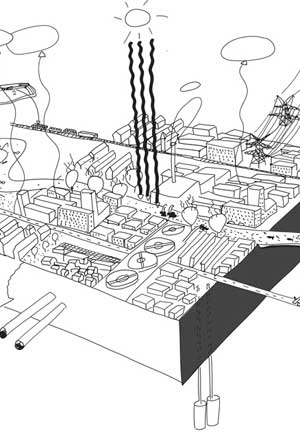
The recent John E. Woltz Symposium at the University of Virginia (UVA) School of Architecture, asked faculty, students, and eight invited panelists to consider “urban metabolism” as a mix of social and ecological flows, structures, and processes. In his keynote address, Scott Lash, a professor at Goldsmiths College, University of London, introduced urban metabolism as the “life-sustaining, dynamic transformations within and between urban objects and urban forms of life. Being life-sustaining, they allow the city to maintain structures, reproduce, and respond to the environment.” While discussion often centers on the flows of the city, urban metabolism, he emphasized, is about structure, form, and objects. It’s imperative to break from standard thinking in order to understand the “being” of the city. “What is at its core?,” asked Lash. The symposium’s goal was to then examine the role of “quasi-objects,” “world objects,” and “hyper-objects” in our understanding of the urban realm.
The morning roundtable consisted of speakers who are practitioners and academics in the disciplines of art, architecture, landscape architecture, and other fields. Jorg Sieweke, Assistant Professor in Landscape Architecture at UVA, in his opening remarks, echoed Lash’s lecture. Using the example of the Mississippi delta, Sieweke said on one hand, natural processes produce the structures that support other natural processes, such as the land-building that occurs when rivers flood. On the other hand, humans attempt to create stability, imposing their own infrastructure, such as levees, dams, and drainage canals. The detrimental effects of this infrastructure can be seen in the rapid erosion and land subsidence of coastal Louisiana. The discussions that followed signaled a paradigm shift away from categorical, binary thinking. However, as Elizabeth Meyer, FASLA, Associate Professor in Landscape Architecture at UVA, cautioned, this is not an entirely new way of thinking.
Dirk Sijmons, principal at H+N+S Landscape Architects in the Netherlands, appointed as the curator of the next International Architecture Biennale Rotterdam, described one such paradigm shift in the Dutch perception of nature. A whale, dubbed Johannes by the media, was recently found disoriented and stranded in the shallow waters off the coast of Holland, creating a public outcry and remarkable efforts to save it and steer it back out to sea. While, sadly, the attempt to save the whale wasn’t successful, it illustrated to Sijmons how much had changed for the Dutch, who were known for their whaling operations as recently as the WW II era. The whale transformed “from a matter of fact to a matter of concern,” a hyperobject, explained Sijmons.
This shifting perception of nature is coupled with the increasing influence of humans on earth’s systems. We have entered a new geologic era called the Anthropocene. Human intervention has altered the geochemical cycles in measurable ways. Humans have influenced sediment flows, ocean currents, climate, biodiversity, and land use. Sijmons suggested that these cycles and processes are not only being altered, but hybridized and can be considered hyperobjects. Moreover, new technologies are, in a sense, enabling the earth to become self-aware. For example, through space imagery, we can more clearly understand the earth as an animate object. The blurred boundary between society and nature necessitates that we reconsider the terms and their conceptions. The 6th Biennale Sijmons is curating, titled “Urban by Nature,” is meant to highlight urban metabolism. The hypothesis of this Biennale is that “these urban tapestries are our nature, our ecology, our habitat, all rolled in one,” says Sijmons.
Responding to Sijmons, Meyer challenged the participants to consider “what is different today in our understanding of these hybrids?” The notion of a hybridized nature is not a new one. Olmsted’s Back Bay Fens in Boston, for example, was a park integrated with a stormwater infrastructure. Meyer emphasized that geographer Erik Swyngedow, analyzing the writings of Karl Marx, wrote that urban metabolism is a socio-ecological process, not a socio-economic one. “Metabolism is more than a metaphor. It’s a way of describing the connection between how we work and the larger historical and geographical ground,” explained Meyer. Perhaps the scale of the issues facing us in the Anthropocene will lead to a more rapid paradigm shift. But Meyer warned, “do not assume that because it’s obvious to us, it’s obvious to everyone.”
Another analysis was offered by Claire Pentecost, a research-based artist. The role of the artist, she said, is to “bring a body of knowledge into a realm of connective tissues of desire and necessity.” Pentecost values bridging different specializations and the connections between bodies of knowledge. The projects she presented seek to stitch together scientific, agricultural, and economic elements and bring them into the realm of art. One such project, done as part of dOCUMENTA(13), deemed the “Olympics of the art world,” in Kassel, Germany, was part of an exhibit titled: “when you step inside you see that it is filled with seeds.” Pentecost quoted Gregory Bateson in describing the goals of her work: “the unit of survival is organism plus environment. We are learning by bitter experience that the organism which destroys its environment destroys itself.” In Pentecost’s project, the seed is the organism and the soil is the environment.
Soil is a microcosm of biologic activity. Yet soil is the number one export of the U.S., said Pentecost, only partially joking. It’s all being washed down the rivers; it has no value. Pentecost’s exhibit proposed soil as a system of currency, “which is ridiculous,” she said, laughing. But the work had a rigorous approach. The rich, composted soil was bound together into ingots using potato starch gluten and dried very slowly so as to maintain its biological life, which goes dormant when dry, but can be revived at a later time. The ingots were arranged on top of gilded glass pedestals for display in the exhibit. In a world where soil is only valued when it’s transformed into real estate, the ingots merged use value with sign value to convey a layered meaning.

During the second set of roundtable presentations, Seth Denizen, researcher at the University of Hong Kong, pushed further into a discussion of soil. Weaving cultural studies and historical discoveries, such as the discovery of the ozone hole, Denizen questioned narratives and language associated with “world objects.” Following this, Martin Felsen, principal of UrbanLab, discussed his projects as part of a larger collaboration that reimagines stormwater systems in Chicago. This work confronts the limitations of centralized, large-scale conventional detention systems. Ryan Bishop, Professor of Global Arts and Politics at University of Southampton, echoed the symposium’s opening, reading a triptych-inspired piece. He questioned the effects of designing with discrete structure and stability in mind when referring to global historical events. In closing, Robin Dripps, Professor of Architecture at UVA, emphasized that objects must be considered in relation to the fields they are in. By positioning objects as fields, we can begin to better understand their being, permutations, and role.
One of the many salient points in the discussion was the human desire for purity. By putting nature and culture into distinct, rational categories, we miss the opportunity to address the quasi-objects that now make up our world. Perhaps as we enter the Anthropocene, interdisciplinary conversations like this one will enable us to begin to imagine solutions that we haven’t yet considered: solutions that are not solely technological, but rather are hybrid responses that take into account, as Meyer put it, the “porous boundary” between us and our environment.