Mostrar mensagens com a etiqueta Gartenpflege und Bewässerung. Mostrar todas as mensagens

Driveway Layout Options


Compare circular, curved, and straight driveway layouts


There are a variety of layout options for residential driveways. For example, you can have a circular drive, a long straight drive, or a driveway with sweeping curves. As with any home improvement project, you'll want to consider function before form. With that in mind there are four main considerations when determining the best driveway layout.

First, is how you want your driveway to function
Do you want room for two cars to pass? Do you need space for a turn-around? How much parking would you like?

Second, is the position of your home's garage
Does your garage face the street? Is it on the side of your home? Or is it a detached garage in the rear of your house?

Third, is your property's terrain
Will your driveway need to traverse a steep slope? Are there mature trees or large boulders you want to work around?

Fourth, is the look you would like to create
Do you want a grand estate-like entrance? Or are you looking for a simple driveway that doesn't distract from your home and landscaping?


Circular Driveways
Circular drives are one of the most popular driveway layouts. Sometimes called a horseshoe driveway, this layout option has an entrance at the road, rounds off as it approaches the house and then has a separate exit lane leading back to the road. This type of driveway is so popular because it eliminates the need for backing out or turning around so that you can always safely enter oncoming traffic in drive with a clear view of the road. A common variation on the circular driveway is the teardrop driveway. A teardrop driveway has only one entry and exit point off the road, but opens into a loop that cars may drive around. Whether a standard half-circle, a horseshoe or a teardrop design, circular drives require quite a bit of room, so they aren't typically an option if you have a small front yard.
Circle Drive
Front Yard Landscaping
Accent Landscapes
Colorado Springs, CO


Curved Driveways
There are a variety of reasons to opt for a curved driveway. First is that the best access point from the street does not line up with your garage, requiring the driveway to curve or angle. Second is that your property has existing trees, boulders or other features that you want your driveway to be designed around. Third is that you are looking to add interest to the overall look of your home and front yard. Whatever reason you have for wanting a curved driveway you'll want to make sure that it is maneuverable for all types of vehicles, from compact cars to large delivery trucks. Broad sweeping curves are the easiest to navigate and look the best. Additionally, you want to avoid placing curves too close to the street or house. This will give drivers time to safely straighten their wheels after leaving the road and before entering a garage or parking space.
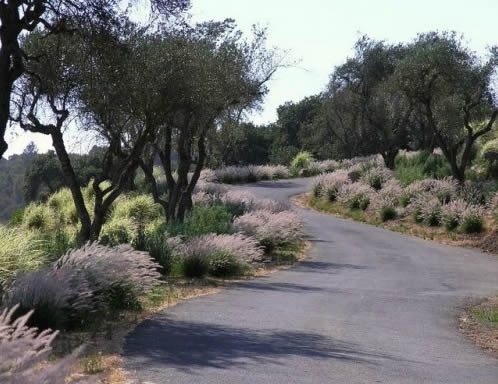
curved driveway
Gentle curves help this driveway blend in amongst the ornamental grasses and olive trees.Michelle Derviss Landscape 
Design in Novato, CA.


Straight Driveways
There are two situations in which a completely straight driveway is appropriate. First is if you have a small front yard and the distance a vehicle will need to travel from street to garage is very short. In this situation your layout options are limited and it is best to keep your driveway simple and functional. Interest can be added to a short, straight driveway with decorative paving materials such as stamped concrete or interlocking pavers, as well as creative driveway lighting and striking plants. Second is if you have a long distance between the street and your home and are looking for an estate-like entrance. A long, straight driveway lined with trees is a great way to welcome guests to your home. This type of driveway layout purposefully directs people's focus to your home, putting it on display.
Allee
Driveway
Maureen Gilmer
Morongo Valley, CA
Gartencenter mit eigener Baumschule an der Algarve mit der größten Auswahl an Pflanzen, Bäume, Wasserpflanzen und Palmen.

Plant Disease Transmission To Humans: Can Virus And Plant Bacteria Infect A Human


No matter how closely you listen to your plants, you’ll never hear a single “Achoo!” from the garden, even if they’re infected with viruses or bacteria. Although plants express these infections differently from humans, some gardeners worry about plant disease transmission to humans – after all, we can get viruses and bacteria, too, right?

Can Plant Bacteria Infect a Human?

Although it would seem like a no brainer to assume that plant and human diseases are distinct and cannot crossover from plant to gardener, this isn’t the case at all. Human infection from plants is very rare, but it does happen. The primary pathogen of concern is a bacteria known as Pseudomonas aeruginosa, which causes a type of soft rot in plants.
P. aeruginosa infections in humans can invade nearly any tissue in the human body, provided they are already weakened. Symptoms vary widely, from urinary tract infections to dermatitis, gastrointestinal infections and even systemic illness. To make matters worse, this bacterium is becoming increasingly antibiotic resistant in institutional settings.
But wait! Before you run to the garden with a can of Lysol, be aware that even in severely ill, hospitalized patients, the infection rate of P. aeruginosa is only 0.4 percent, making it highly unlikely that you will ever develop an infection even if you have open wounds that come in contact with infected plant tissues. Normally-functioning human immune systems make human infection from plants highly improbable.

Do Plant Viruses Make People Sick?

Unlike bacteria that can function in a more opportunistic fashion, viruses need very exacting conditions to spread. Even if you eat fruits from your squash mosaic infected melons, you won’t contract the virus responsible for this disease (Note: eating fruits from virus-infected plants isn’t recommended – they’re not usually very tasty but won’t hurt you.).
You should always cull virus-infected plants as soon as you realize they’re present in your garden, since they are often vectored from sick plants to healthy ones by sap-sucking insects. Now you can dive in, pruners blazin’, confident that there’s not a significant connection between plant diseases and humans.

Lafitte Greenway + Revitalization Corridor | Linking New Orleans Neighborhoods


  • Lafitte Greenway + Revitalization Corridor | Linking New Orleans Neighborhoods
  • Lafitte Greenway + Revitalization Corridor | Linking New Orleans Neighborhoods
    Close Me!
    The Lafitte Greenway, a 54-acre barren stretch of land once used as an industrial rail corridor, is poised to become a catalyst for change in the Crescent City.

    Image: John Moon, Design Workshop
    Image 2 of 16
  • Lafitte Greenway + Revitalization Corridor | Linking New Orleans Neighborhoods
    Close Me!
    The brownfield site known as the Lafitte Greenway crosses seven historic New Orleans neighborhoods. While the Greenway currently acts as a divider of these neighborhoods, the design and revitalization strategy aims to unite these communities on a common ground.

    Image: Design Workshop
    Image 3 of 16
  • Lafitte Greenway + Revitalization Corridor | Linking New Orleans Neighborhoods
    Close Me!
    Between 1800 and 1900, the railroad and Carondelet Canal served as extensions of Bayou St. John that facilitated trade to the City. The bayou was channelized and tree canopy severely degraded, as this once rich ecosystem diminished due to urbanization.

    Image: Design Workshop
    Image 4 of 16
  • Lafitte Greenway + Revitalization Corridor | Linking New Orleans Neighborhoods
    Close Me!
    As the area re-emerged as a potential Greenway, the design team investigated systems that speak to the restoration of history, hydrology and ecology. The Canal and railroad are revealed through the use of linear rain gardens and a multi-modal transportation network.

    Image: Design Workshop
    Image 5 of 16
  • Lafitte Greenway + Revitalization Corridor | Linking New Orleans Neighborhoods
    Close Me!
    The Greenway trail weaves through fields, orchards, rain gardens, and recreational spaces, creating dynamic experiences across the site. The Greenway is transformed into a spine that not only connects neighborhoods, but provides distinction of design, function, context, and environmental responsibility.

    Image: Design Workshop
    Image 6 of 16
  • Lafitte Greenway + Revitalization Corridor | Linking New Orleans Neighborhoods
    Close Me!
    An in-depth analysis of the New Orleans landscape typologies shows the diverse ecotones that bisect the Corridor and Greenway. Subtle changes in elevation inform the planting design that determines which types of plant species will thrive in this complex environment.

    Image: Design Workshop
    Image 7 of 16
  • Lafitte Greenway + Revitalization Corridor | Linking New Orleans Neighborhoods
    Close Me!
    The immense amount of support for the design and construction of the Greenway resulted in a plan that was truly created by a collective effort from the City, stakeholders, community members, and the design team.

    Image: Design Workshop
    Image 8 of 16
  • Lafitte Greenway + Revitalization Corridor | Linking New Orleans Neighborhoods
    Close Me!
    Research of the hydrology revealed that the Greenway is a high point and actually causes localized flooding of adjacent homes and businesses. Strategies to mitigate stormwater runoff include carving out recreation fields that double as natural stormwater reservoirs.

    Image: John Moon, Design Workshop
    Image 9 of 16
  • Lafitte Greenway + Revitalization Corridor | Linking New Orleans Neighborhoods
    Close Me!
    Portions of the historic canal are re-envisioned as recreational spaces and provide artistic opportunities to display ecological and historic processes. By capitalizing on existing infrastructures, the design achieves the goal of mitigating stormwater and increasing quality of life.

    Image: Design Workshop
    Image 10 of 16
  • Lafitte Greenway + Revitalization Corridor | Linking New Orleans Neighborhoods
    Close Me!
    The historic alignment of the Canal is retrofitted as a rain garden with 100-percent native plant material. The design achieves environmental sustainability by restoring the native ecology and increasing habitat for wildlife, while providing essential recreation space for the community.

    Image: Design Workshop
    Image 11 of 16
  • Lafitte Greenway + Revitalization Corridor | Linking New Orleans Neighborhoods
    Close Me!
    While there is some park space and neutral grounds for recreation, the area lacks sufficient programming and connectivity. A significant goal of the plan is to provide program elements determined by the local community while ensuring the safety of visitors.

    Image: John Moon, Design Workshop
    Image 12 of 16
  • Lafitte Greenway + Revitalization Corridor | Linking New Orleans Neighborhoods
    Close Me!
    Programmatic elements identified by Corridor residents are integrated into the park, achieving access to health and wellness. Open spaces are passively ventilated, providing areas of human comfort while also reducing vulnerability to environmental stresses.

    Image: Design Workshop
    Image 13 of 16
  • Lafitte Greenway + Revitalization Corridor | Linking New Orleans Neighborhoods
    Close Me!
    The rich history and mix of neighborhood identities are reflected in the design strategy for the Greenway and recommendations of the plan. Instead of acting as a barrier of neighborhoods, the Greenway seeks to unite residents and foster community interaction.

    Image: Design Workshop
    Image 14 of 16
  • Lafitte Greenway + Revitalization Corridor | Linking New Orleans Neighborhoods
    Close Me!
    Transforming the existing City-owned building into an open-air pavilion with community gardens and rainwater collection system offers new solutions for existing structures. Incorporating historic buildings within the Greenway achieves economic sustainability and provides meaningful gathering space for community events.

    Image: Design Workshop
    Image 15 of 16
  • Lafitte Greenway + Revitalization Corridor | Linking New Orleans Neighborhoods
    Close Me!
    The plan responds to the needs of the community and replenishes the barren stretch of land into a lush Greenway. Most importantly, this plan capitalizes on underutilized public space, bringing the citizens of New Orleans together on a common ground.

    Image: Design Workshop
    Image 16 of 16
Project Statement
As one of the first revitalization projects since the devastation of 2005's Hurricane Katrina, the 3.1-mile linear Lafitte Greenway will become a vibrant, multi-modal transportation corridor linking residents to the heart of New Orleans, Louisiana. The landscape architect led a multi-disciplinary effort—incorporating public input, synthesizing many measurable objectives and working across a range of scales—to transform an old industrial rail corridor into a celebrated Greenway.
Project Narrative
This has legs and was done without a lot of budget. The information is conveyed clearly and logically. The cultural and environmental aspects are good. The documentation is excellent and the renderings are beautiful. It shows there was a lot of community involvement in New Orleans.

—2013 Professional Awards Jury

The Site

The 54-acre Lafitte Greenway was once a former shipping canal and railroad right-of-way that connected the historic French Quarter to Bayou St. John and Lake Pontchartrain. The Lafitte Corridor is a 1,375-acre district that includes the Lafitte Greenway and a rich mix of residential, retail and industrial uses. The Corridor contains 13,583 residents and traverses a cross-section of the City reflecting 200-year settlement patterns ranging from the colonial-era settlement of the Vieux Carré to the mid-twentieth-century suburban neighborhood of Mid-City. Presently, this district contains a spectrum of socioeconomic conditions and racial compositions, creating a challenging context for community engagement.

The Challenge

The City of New Orleans retained a multi-disciplinary team to complete four comprehensive tasks: 1) the Lafitte Greenway Master Plan, 2) the Lafitte Corridor Revitalization Plan 3) construction documents for the Greenway and an 4) Operations and Maintenance Plan. This extraordinary effort required the design team to assess the role of the Greenway within the City as a whole, identify a revitalization strategy for the entire Corridor and create a detailed design for the implementation of the Greenway. The consultant team planned and designed at these three distinct scales but also advised on the important management, budget and operations of the Greenway.

Process

In planning and designing the Lafitte Greenway, the consultant team followed a rigorous process to ensure that the work resulted in extraordinary outcomes with measurable results. Understanding critical questions through five overarching design principles—History, Environment, Art, Community and Economics—was paramount to creating a project that was sustainable for the long term. These questions helped the team form goals that were Specific, Measurable, Action-oriented, Realistic and Time-based (SMART). For each SMART goal, at least one metric with an associated baseline existing condition was established by which success could be measured. Best practices, case studies and research from sources such as LEED® ND and American Forests were compared to establish benchmarks for each metric. This process resulted in a set of strategies that has been integrated into the design of the Greenway and the revitalization recommendations for the Corridor.

Garnering Community Support

The community engagement approach was inclusive of all segments of the New Orleans community, with specific focus on neighborhoods and organizations within the Corridor. The overall strategy involved a series of three public meetings, eight public presentations, over 75 stakeholder meetings, online surveys and Chip Game events with 12 constituent groups. The Chip Game was a collaborative exercise allowing the community to suggest types of park facilities and landscape treatments appropriate to the Greenway. The foundation of the game was developed through recommendations for park programming based on the Corridor's population of 13,583 residents. Chip Game results allowed the consultant team to develop a local park program standard which could be used as a guide for future park planning in the city. The Chip Game was played by various stakeholder groups of the Lafitte Greenway including the Friends of Lafitte Corridor, community members, and students from the local high school and elementary school.

Envisioning the Greenway

The overall design concept draws upon principles of historic ecology and builds upon the rich layers of the site's history while also taking into account community input and previous plans. The historic alignment of Carondelet Canal is marked by a mile-long bosque of bald cypress trees evocative of the Cipriére au Bois (Cypress Forest) that once covered the site. Within this grove is an ephemeral rain garden filled with stunning displays of native Louisiana iris, New Orleans' city flower. Rust stained bands of paving trace the location of train tracks once traversing the site. Plantings reflect the natural vegetation patterns of south Louisiana with swamp species that transition to bottomland hardwoods and upland species as the Greenway rises to the Metairie Ridge and natural level of the river.
The design creates synergies between existing community facilities and designed elements of the Greenway, providing open space for formal and informal activities. Geo-referencing of 18th century maps identified the location of the Carondelet Walk, a historic tow path of the Carondelet Canal. The new Carondelet Walk of crushed, recycled brick provides a secondary path within the park and a grand promenade, much as the original had done 200 years before. In addition to a fine walking surface, according to New Orleans tradition, a line of red brick dust wards away enemies and evil spirits! A new community garden is placed where the Lafitte community garden, once the longest continuously operated community garden in America, was located.

Sustainable Principles

The design for the Greenway incorporates sustainable design through green stormwater infrastructure, native plantings, adaptive re-use of existing buildings and the reduction of impervious surface. The Lafitte Greenway will be one of the first projects in New Orleans that creates measurable outcomes that aim to lessen the effects of urban heat island and increase stormwater management capacity. Specifically, the restoration of the natural edge conditions of Bayou St. John will encourage fish and wildlife habitat, support biodiversity and increase water quality. The reconfigured community space will provide a hill and amphitheater for local community festivals such as Bayou Boogaloo.

The Revitalization Plan

In addition, the landscape architects were called upon to lead an economic revitalization strategy for the surrounding Corridor. Strategies were developed for Safe Routes to School, for a dramatic expansion of the community gardening program which will exceed LEED® standards, and for the creation of nodal mixed-use development at major intersections. The landscape architects worked to ensure the Greenway was zoned as open space, thus avoiding use of the land for other purposes. A set of form-based development standards will supplement the City's new zoning ordinance to ensure orderly infill in response to this new civic asset. A Corridor-wide strategy for stormwater management will also address the district's historic flooding problems.

Implementing the Vision

As the Greenway will employ the most extensive use of green infrastructure and native plant material in the City's history, it is not sufficient to merely build the Greenway; there must also be a strategy for its operation and management. New Orleans is unique among American cities in that park operations are divided between two entities: Parks and Parkways and the New Orleans Recreational Development Commission. It was necessary, therefore, for the landscape architect to prepare a maintenance budget and protocols as well as to negotiate the management of the Greenway between these two entities. In addition, although it is estimated to cost $35 million to construct the Greenway, these two entities have only $6.5 million dollars available for construction. Thus, in a severe climate of fiscal austerity, the landscape architect was also called upon to develop a partnership program in which various civic groups could develop and fund portions of the project.

Measuring Success

Working within a holistic, sustainable design framework, the landscape architects created a system of performance metrics, baseline measurements and benchmarks in the categories of history, environment, community, economics and art which far exceed those of LEED® or Sustainable Sites. A number of positive outcomes will be achieved. For example, restoring the historic Cypress tree canopy will result in an increase from three-percent to 46-percent tree canopy coverage. One-hundred percent of the storm water falling on-site during the 10-year storm will be captured without the use of pipes, thus lessening the load on New Orleans' already overtaxed stormwater system and reducing subsidence. Finally, through the use of 100-percent native plant material, wildlife and bird populations are projected to quadruple.

Future

The plan successfully responds to the needs of adjacent communities and it replenishes the barren stretch of land into a lush, vibrant Greenway. Most importantly, this plan gives back to the City of New Orleans and capitalizes on underutilized public space, bringing the citizens of New Orleans together on a common ground. By taking a comprehensive approach to analysis and implementing a robust planning process, the Lafitte Greenway considers all voices of the people and breathes life into an iconic Greenway.
Project Resources

Daily Dream Home: Sense House


Daily Dream Home: Sense House

Searching for a way to enjoy a constant sensory experience within their living environment, the inhabitants of this dream home in Tokyo, Japan asked Japanese architect Kazutoshi Imanaga to design a home that would suit their needs and wishes. This is how the Sense House was built – a unique home unveiling its naturally lit spaces over a surface of 3,660 square feet.
Opening the living experience to a world of the senses by employing architectural solutions, the architect created a soothing environment, where children laughing in swings by the pool can be seen and heard from the living room. The courtyard is visually interconnected with the interiors through dark-framed glass walls and sliding doors. The open floor plan downstairs incorporates the living, dining, kitchen, study space and play area. By placing furniture and a fireplace as room separators, the architect created an intimate yet spacious multipurpose space. An indoor pool – easy to open to the outside – ensures the family gets plenty of exercise.
Sense House by Kazutoshi Imanaga (2)
Sleek modern architectural elements like the staircase or glass bridge crossing the double-height living area accentuate the pleasure of the visual senses, the garden offers the smell of freshly cut grass and the feel of the breeze and warm sunshine, while the water features create a natural sound background that completes the serene atmosphere.
This is what luxury is all about – creating a sensory experience, don’t you think?
Sense House by Kazutoshi Imanaga (3)Sense House by Kazutoshi Imanaga (4)Sense House by Kazutoshi Imanaga (5)Sense House by Kazutoshi Imanaga (6)Sense House by Kazutoshi Imanaga (7)Sense House by Kazutoshi Imanaga (8)Sense House by Kazutoshi Imanaga (9)Sense House by Kazutoshi Imanaga (10)

Garden and landscaping

Improve Your Home and Garden
Word “Home” is the second name of joy ,comfort and relaxation from bitter life outside. No matter how is your home…its big or small ….congested or wide .A home have all the comforts which is desired by every human after a hectic day of work. Like any other institution ,home also owns some departments.
Each “Department” of home performs any specific task to ease its residents. Kitchen supplies you food. Bedrooms give a warm lap to sleep in. TV lounge acts as an entertainment corner .In the same way we take Garden as the utmost source of observing nature .A Garden have trees ,plants ,pots and grass in common.
Some people who love plants company decorate their garden with numerous types of flowers and plants. These plants are the perfect designs of nature. A garden in a home makes its attractive and close to nature where you can walk naked feet and breath like the time you breath first. Gardens add beauty and life to the home. Its said by a philosopher that a Home with out garden is like a box with living dolls in it.
A garden in a home requires a little attention but give more benefit. If you are interested in having a garden in your home then you can use you own ideas but for more expertise its recommended to hire a gardener. you can plant everything from trees to vegetables in your garden.
You can renovate it by putting a carpet of green grass. With utilizing you artistic sense you can draw long strips of any plant over walls.
Your Garden can be more beautiful and lively if you place some water pots in Garden for the birds so that they can visit your garden and enhance the intense sign of life. Some pets like turtles ,pigeons can also be kept in Garden to give it a wild deep forest look.
For having a beautiful garden keep the following tips in mind:
  1. Choose those plants which are according to your city’s weather like you can plant apple trees in Quetta with very ease but you cant plant mango plant in your garden since its suitable for sindh and any other warm place.
  2. Make the arrangement of garden in such a way where you can walk ,see and look after every corner of it.
  3. Dont forget to put chemical or natural fertilizers as needed .So,that they can enhance the plant growth.
  4. Buy some beautiful painted pots to place it in your garden.
  5. Supply sufficient water especially in summers so that all your efforts should not go in vein.
Gardens add life to your home…..Put Life ……Make Garden…!

Arranjos exteriores ,all aspectos of landscaping service

The Eternal Melodies of Wind Chimes
The subtle melodious tunes of wind chimes, when it dangles sweetly with slightest breeze, set an ambiance of soothing tranquility throughout our natural environment. Be it the front porch, balcony, backyard or in bedroom window, Wind chimes brings about an enchanting ambiance, when its soft and sweet music touches our ears, envelops our soul within its gentle musical feel.
Wind chimes‘ extremely calming notes have an amazing power to take us on to a spiritual journey, In ancient China, wind chimes were believed to carry good health, fortune and prosperity through the beautiful tunes. Besides wind chimes were used in temples and spiritual ceremonies, even today in India, wind chimes are found in temples and religious places.
The soft harmonious hymns also contain healing effects. For years, cultures from various civilizations have utilized the benefits of wind chimes to restore and calm the spirit. Its soothing tunes help to calm the mind while relieving stress.
For relaxing and soothing purpose, hang wind chimes in your garden, where your eyes can enjoy the fragile beauty of nature and your ears can indulge into a musical pleasure.
If you want to create soft and romantic atmosphere, hang wind chimes in your bedroom window, where you can enjoy a soft and caring night while talking to your man and listening to the gentlest music as you drift off to sleep.
These unforgettable melodies bring with them some precious memories of older days, melodies that makes you feel nostalgic, that makes you lost into the beauty of childhood days. Words may die, but melodies are eternal, and so is their effect, everlasting and timeless. Perk up your life with the music of these eternal melodies and capture the beauty of each and every moment within your heart.

Envolvida na mais verde paisagem, com o azul do mar e do céu num bailado constante fomos encontrar aquela que é a ilha mais ocidental da Europa, no meio do Oceano Atlântico. Falamos da ilha das Flores, uma das nove pertencentes ao Arquipélago dos Açores, onde a Natureza continua a ser rainha.


Envolvida na mais verde paisagem, com o azul do mar e do céu num bailado constante fomos encontrar aquela que é a ilha mais ocidental da Europa, no meio do Oceano Atlântico. Falamos da ilha das Flores, uma das nove pertencentes ao Arquipélago dos Açores, onde a Natureza continua a ser rainha.


Os 143,11 quilómetros quadrados de superfície que a compõem estão repletos de surpresas para quem a visita e, ao virar de cada curva, um novo cenário se nos depara com uma nova luz, cores e sons únicos.


Vizinha da ilha do Corvo - que se avista na perfeição, caso o tempo o permita - as Flores são ideais para os amantes da Natureza, dos longos caminhos pedestres, da observação das aves ou apenas das ondas do mar. Praias, piscinas naturais e lagoas são constantes por ali e convidam ao mergulho e ao descanso.


Apesar de se desconhecer ao certo em que data terá sido descoberta, os historiadores acreditam que esta terá sido povoada entre 1450 e 1452 pelo navegador Diogo Teive. No entanto, o seu isolamento levou ao abandono da mesma e só em 1504 terá assistido ao seu povoamento definitivo com gentes provenientes das ilhas da Terceira e Madeira e alguns continentais.


Mas voltemos ao presente, já que a ilha, que durante anos viveu mais isolada, começa agora a ganhar mais vida, principalmente com a abertura recente do Hotel das Flores, uma unidade hoteleira de quatro estrelas cuja exploração está a cargo da Inatel e que desde os finais de Agosto garante à ilha um serviço que há muito se esperava.


Para Morais Lopes, director daquele hotel cujo investimento rondou os cinco milhões de euros, a ocupação tem sido uma agradável surpresa e o feedack dos turistas, essencialmente alemães, franceses e italianos "é muito positivo e já temos muitas reservas para o ano que se avizinha".


Com 26 quartos, um quarto para pessoas com deficiências motoras e uma suite, o Hotel das Flores, em Santa Cruz das Flores, para além da vista com o Corvo no horizonte, disponibiliza um restaurante, bar, ginásio, piscina exterior, room service, entre outros serviços.


Para Morais Lopes a estadia de uma semana é o ideal para quem procura as Flores e actividades é coisa que não falta por aqui.


Senão veja-se...


Percursos Pedestres


Visitar a ilha através dos percursos pedestres existentes é talvez a melhor opção. Comecemos pelo mais fácil. São quatro quilómetros para fazer em duas horas no percurso Fajã de Lopo Vaz. O início e o fim são no Miradouro da Fajã de Lopo Vaz e progride por uma descida em que o trilho alterna entre terra batida, calçada e degraus em pedra. A exploração da Fajã fica ao critério de cada um dos visitantes, que podem encontrar uma fonte com água potável, uma praia, pequenos terrenos agrícolas e cabras selvagens.


Passando para o percurso seguinte, este com sete quilómetros e uma caminhada de três horas, o seu início dá-se no Miradouro das Lagoas, terminando na Poça do Bacalhau. Pelo caminho é possível ver-se a Caldeira Seca, a Fajã Grande e seguir junto à Ribeira das Casas até à Poça do Bacalhau.


E se percorrer trilhos bem juntinho à Natureza é já razão mais do que suficiente para visitar as Flores, encontrar uma aldeia recuperada para turismo é no mínimo tentador. Para lá do aeroporto das Flores, a oeste da ilha, na freguesia da Fajã Grande fomos encontrar a Aldeia da Cuada. Um pequeno planalto sobranceiro à foz da Ribeira Grande. Ficar nas pequenas e grandes casas de pedra que se espalham pela aldeia, conservando mobiliário e objectos de outrora, transporta-nos a tempos idos. Equipadas com cozinhas e casa de banho, além de amplos quartos, as 16 moradias da Aldeia da Cuada respeitam todas as regras de segurança. Se é fã de turismo da aldeia, apresse-se a fazer a reserva. É que este é um empreendimento muito procurado, principalmente nos meses de Verão. Para quem quiser ficar a conhecer mais, nada melhor do que visitar o site www.aldeiadacuada.com.


Fazer rafting ou um passeio marítimo para ficar a descobrir as inúmeras grutas que circundam a ilha e que já foram esconderijos de piratas podem ser programas alternativos.


A antiga fábrica da baleia, em Santa Cruz das Flores, deu agora lugar a um Centro de Interpretação da ilha. Ao longo de várias salas, o visitante é convidado a conhecer de perto a génese da ilha, os animais terrestres e aquáticos que a compõem e o fundo do Oceano Atlântico. Pelo meio ouvem-se os cagarros, aves muito observadas na zona e que são agora espécie protegida.


Já falámos de passeio, já arranjámos estadia, está na hora de comermos qualquer coisa. A oferta não é muita, mas nós recomendamos um restaurante na Fajãzinha, o Pôr-do-Sol.


Com decoração rústica, o restaurante faz-nos sentir em casa. Albacora no forno com batata-doce, Carne assada com castanhas ou uma Feijoada Tradicional com inhame faziam parte do menu quando por lá passámos. A Delícia de Amoras ou o Pudim de Côco fechavam com chave de ouro uma ementa onde não faltaram os queijos regionais, o pão de milho e os torresminhos, tudo regado com vinho Terras de Lava.